


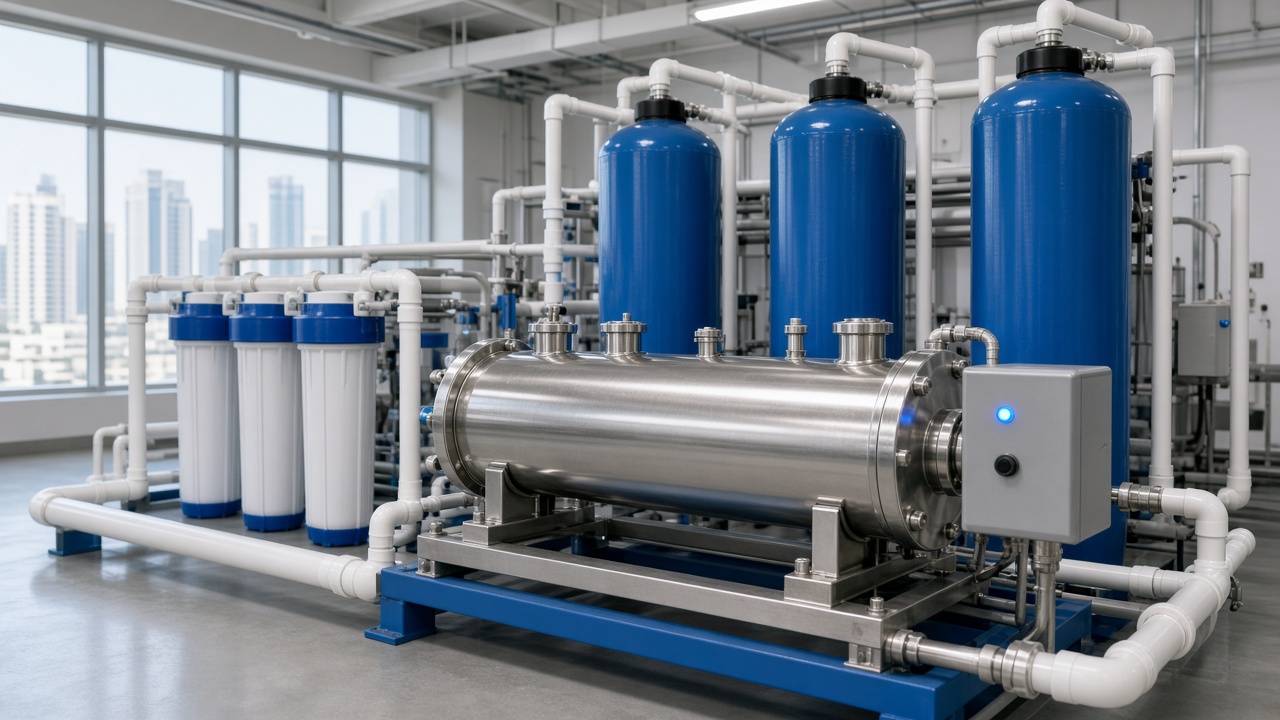
Introduction
Filtration and reverse osmosis remove suspended solids, dissolved salts and many contaminants. But clean-looking water is not automatically safe water. Bacteria, viruses and protozoa can survive in storage tanks, pipework and the stages after treatment, especially in warm climates where microbes multiply quickly.
UV water sterilizers close that gap with a simple, chemical-free step. Ultraviolet light inactivates microorganisms as water flows through the unit. Nothing is added to the water, so there is no change to taste or odour and no disinfection by-products. That is why UV disinfection is now standard in hotels, commercial buildings, food and beverage plants, bottled water lines and industrial process water systems.
As a water treatment equipment supplier in the UAE, Aqua Flair Trading LLC supplies UV sterilizers, including Viqua units, and helps contractors and integrators fit UV disinfection correctly into complete treatment trains. If you are planning a project, contact our team with your flow rate and water analysis.
Why UV disinfection matters in UAE water systems
In the UAE, water is often desalinated, moved through long networks and then held in rooftop or underground tanks before use. High ambient temperatures, long storage times and low residual chlorine all raise the risk of bacteria growing again before the water reaches the tap or the process line.
A correctly sized UV sterilizer helps protect:
- Microbiological safety of drinking and process water
- Product quality in food, beverage and bottled water production
- Guests and occupants in hotels, hospitals and commercial buildings
- RO permeate and storage tanks from regrowth after treatment
- Taste and odour, because no chemicals are added
- Compliance with the disinfection requirements set by consultants and end users
UV works alongside filtration and RO. It does not replace them. Membranes and filters remove contaminants, and UV adds a final barrier against living microorganisms. If you are new to the upstream stage, our guides Reverse Osmosis (RO): The Purest Water Solution and How Water Treatment Systems Work show where disinfection fits.
How UV sterilizers work
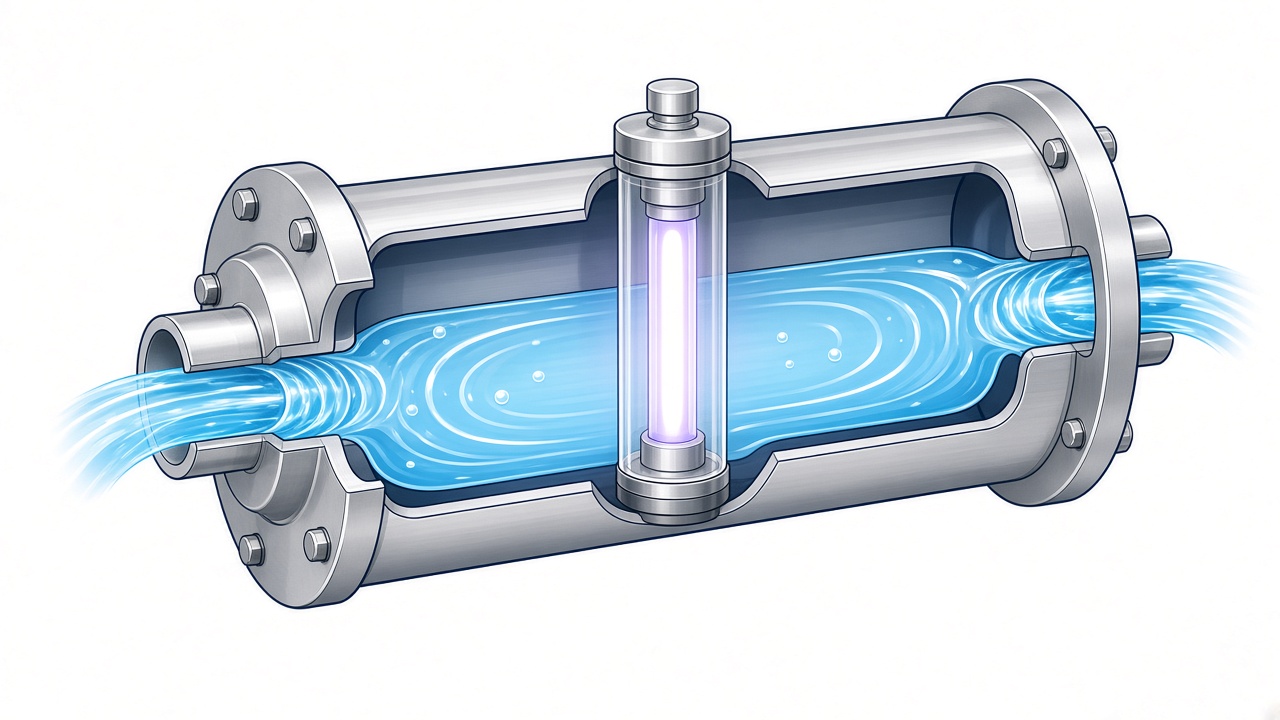
Inside the stainless steel chamber, a UV-C lamp sits in a quartz sleeve. As water passes the sleeve, it is exposed to germicidal ultraviolet light at about 254 nm. This light damages the DNA of bacteria, viruses and protozoa, so they can no longer multiply or cause infection. The microorganisms are inactivated, not removed, which is why UV is paired with filtration.
How well this works depends on the UV dose: the light intensity multiplied by the time the water spends in the chamber. The dose drops when:
- flow rises above the unit’s rating,
- the water is cloudy or contains iron, hardness or tannins, or
- the quartz sleeve is scaled or dirty.
That is why sizing and pretreatment matter as much as the UV unit itself.
What to check when specifying a UV sterilizer
1. Flow rate and UV dose
Size the unit for the peak flow rate, not the average. If flow goes above the rating, contact time and dose fall, and disinfection becomes unreliable. Confirm the dose required for your application (measured in mJ/cm²) before choosing a model, and ask the supplier to state the flow at which the unit delivers that dose. A flow meter on the line confirms the unit never runs above its rating.
2. UV transmittance (UVT) of the feed water
UVT measures how easily UV light passes through the water. RO permeate and well-filtered municipal water usually have high UVT. Raw well water or poorly filtered supplies may need a larger unit or better pretreatment. Use measured UVT values in the design, not assumptions.
3. Pretreatment and water quality limits
Suspended solids can shield microorganisms from UV light. Hardness and iron can coat the quartz sleeve. Good pretreatment helps the sterilizer deliver its rated dose:
- Pre-filtration, typically around 5 micron, using cartridge filters, pleated filter cartridges or bag filters
- Media filtration for turbidity and iron, using filtration media in FRP vessels
- Where hardness or iron would coat the sleeve, a softening or iron removal stage with automatic control from Clack valves
4. Position in the treatment train
UV is usually installed after filtration, softening or RO, and as close to the point of use as practical. In buildings with storage tanks, a UV unit on the tank outlet, or on the supply side of the booster pumps, helps control regrowth caused by storage.
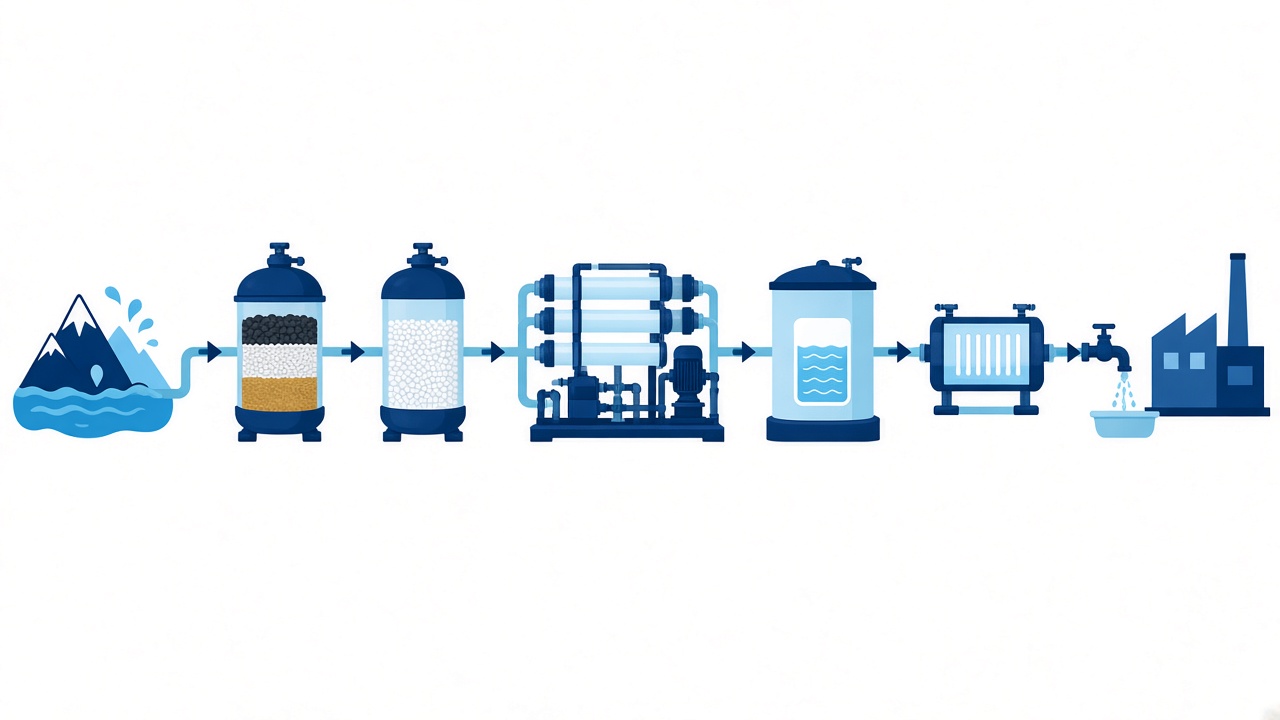
A typical order for a commercial system is:
- Raw or municipal water
- Sediment and media filtration
- Softening or carbon, where needed
- Cartridge filter
- RO system
- Storage tank
- UV sterilizer
- Point of use or process line
[Image: UV sterilizer placement in a typical treatment train]
Alt text: Diagram of UV sterilizer placement after filtration, RO and storage in a water treatment train.
5. Lamp life and monitoring
UV lamps lose output over time even when they still light up. Lamp life is typically around 9,000 hours, which is roughly one year of continuous operation, but check the model’s datasheet. Units with UV intensity sensors, lamp-life timers and alarms let operators confirm performance instead of guessing.
6. Materials, power and serviceability
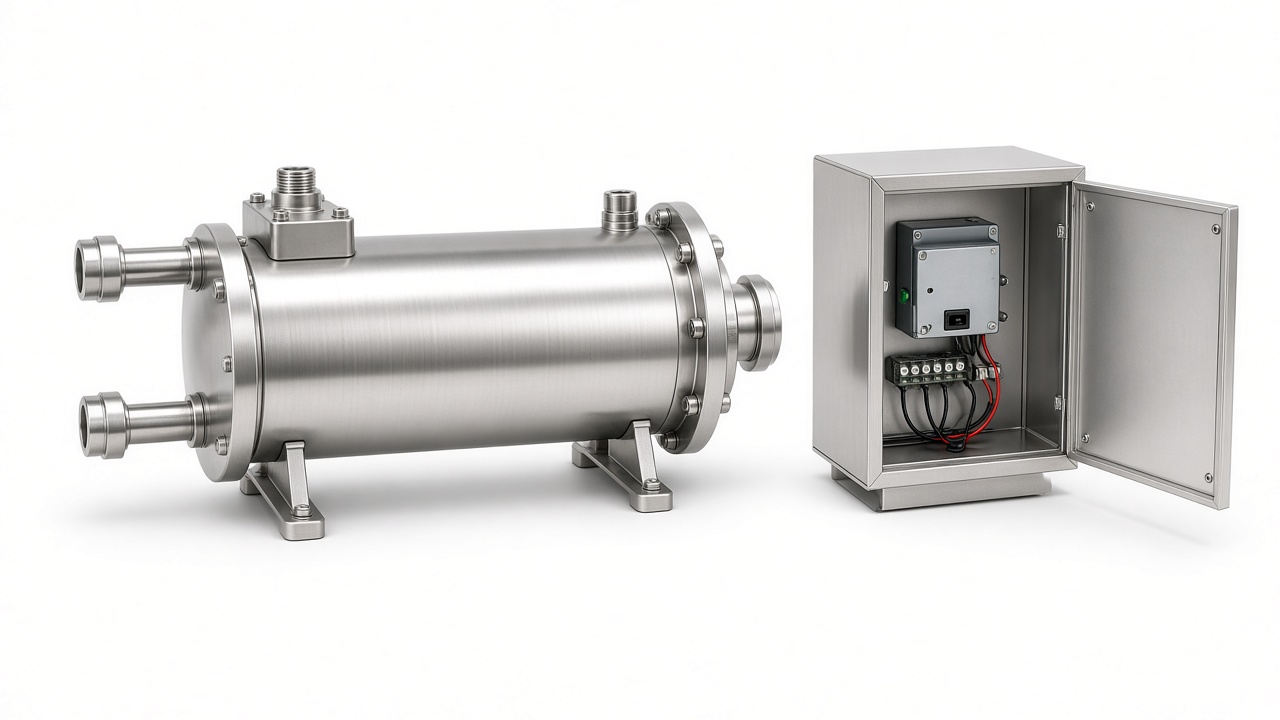
Stainless steel chambers, a stable power supply and space to remove the lamp and sleeve all affect long-term reliability. Plant rooms in the UAE can run hot, so leave room for ventilation and easy maintenance access.
Where UV is used
| Application | Why UV is used |
|---|---|
| Hotels, resorts and apartment buildings | Controls regrowth in rooftop and underground tanks before the water reaches guests |
| Hospitals and clinics | Adds a final barrier on drinking and general-use water |
| Food and beverage plants | Protects ingredient and rinse water without adding chemicals |
| Bottled water lines | Final disinfection after RO and before filling |
| Industrial process water | Controls microbial growth in process and make-up water |
| Commercial RO systems | Keeps permeate and storage tanks free of regrowth |
What UV sterilizers solve, and what they do not
UV is a highly effective disinfection step, but a targeted one. Knowing its limits helps you design a complete system.
UV disinfection helps address
- Bacteria, viruses and protozoa in treated water
- Regrowth risk after RO and in storage tanks
- Disinfection without chemical handling, dosing or by-products
- Final polishing for drinking water, food and beverage, and process water
UV alone cannot fix
- Dissolved salts, hardness, heavy metals or chemical contaminants
- Turbid or iron-rich water that blocks UV light
- Contamination that enters pipework after the UV unit, because UV leaves no residual disinfectant
- Undersized units running above their rated flow
Where a residual disinfectant is needed in long distribution networks, UV is often combined with controlled chemical dosing through a dosing pump and a dosing tank. Engineers decide this based on the system layout and project requirements.
UV and RO: why they work well together
RO membranes remove dissolved salts and most microorganisms, but permeate then passes into tanks and pipework where bacteria can return. Permeate also has high UV transmittance, so UV after RO is a common and effective setup. If you run RO, protect the membrane first. Our Complete Guide to RO Membranes and the RO membrane range cover selection and care, and the 800 GPD commercial RO system is an example of a package that pairs naturally with a UV stage.
Getting more reliability from UV-equipped systems
UV systems perform consistently when equipment, pretreatment and maintenance are planned together:
- Size for peak flow and the required dose, using realistic UVT values for your feed water.
- Install proper pre-filtration, and soften or remove iron where hardness or iron would coat the sleeve.
- Replace lamps on schedule, not only when they fail, because output drops before a lamp goes out.
- Clean or inspect quartz sleeves regularly, especially with hard water or where water sits still in the chamber.
- Monitor UV intensity with sensors and alarms on commercial and industrial installations.
- Check water quality routinely with suitable water quality meters for TDS, pH and turbidity, so upstream problems are caught early.
Maintenance schedule
| Task | Typical frequency |
|---|---|
| Replace UV lamp | About every 9,000 hours (check the datasheet) |
| Inspect and clean quartz sleeve | At each lamp change, more often in hard water |
| Check UV intensity sensor and alarms | Regular operator checks |
| Replace upstream filter cartridges | On differential pressure or schedule |
| Check flow against the unit rating | At commissioning and after any system change |
When a UV sterilizer is matched to a well-designed RO, filtration or softening system, it gives a dependable, low-maintenance final barrier for safe water.
Frequently asked questions
Do UV sterilizers change the taste or chemistry of water?
No. UV disinfects water without adding chemicals, so taste, odour and mineral content stay the same.
Can a UV sterilizer be used after an RO system?
Yes. RO permeate usually has high UV transmittance, so UV after RO is a common and effective setup for drinking, bottled and process water.
How often should UV lamps be replaced?
Typically about once a year in continuous operation, around 9,000 hours, though this varies by model. Replace lamps on schedule even if they still glow, because germicidal output declines over time.
Is pre-filtration required before a UV unit?
In most cases, yes. Suspended solids, iron and hardness reduce UV performance, so pre-filtration and suitable pretreatment protect disinfection results.
Does UV leave a residual disinfectant in the pipework?
No. UV disinfects only the water passing through the chamber. Where a residual is required in long distribution networks, UV is combined with controlled chemical dosing.
Can UV remove salts, hardness or chemical contaminants?
No. UV inactivates microorganisms only. Salts, hardness and chemicals need RO, softening or other treatment upstream.
Commercial UV water sterilizers from Aqua Flair
Aqua Flair Trading LLC supplies UV sterilizers from brands such as Viqua, alongside RO systems, filtration, softening and dosing equipment. We provide ready stock in Dubai, delivery across the GCC, and technical guidance on sizing and system integration. You can see everything we supply on our products page.
Conclusion
UV water sterilizers give commercial and industrial water systems a simple, chemical-free way to control microbiological risk. They are especially valuable in the UAE, where storage, heat and long distribution runs make regrowth a real concern. Performance depends on correct sizing, good pretreatment and disciplined lamp and sleeve maintenance.
For UV sterilizer selection, stock availability or help integrating UV with RO, filtration and softening systems across the UAE and GCC, request a quote and our team will recommend a suitable configuration.
Share this story


