


Introduction
Industries using water in day-to-day work operations must never allow quality standards to be reduced. All hotel facilities in Dubai and all manufacturing plants and pharmaceutical facilities depend completely on water to achieve optimal performance, guarantee safety, and maintain reasonable operating expenses.
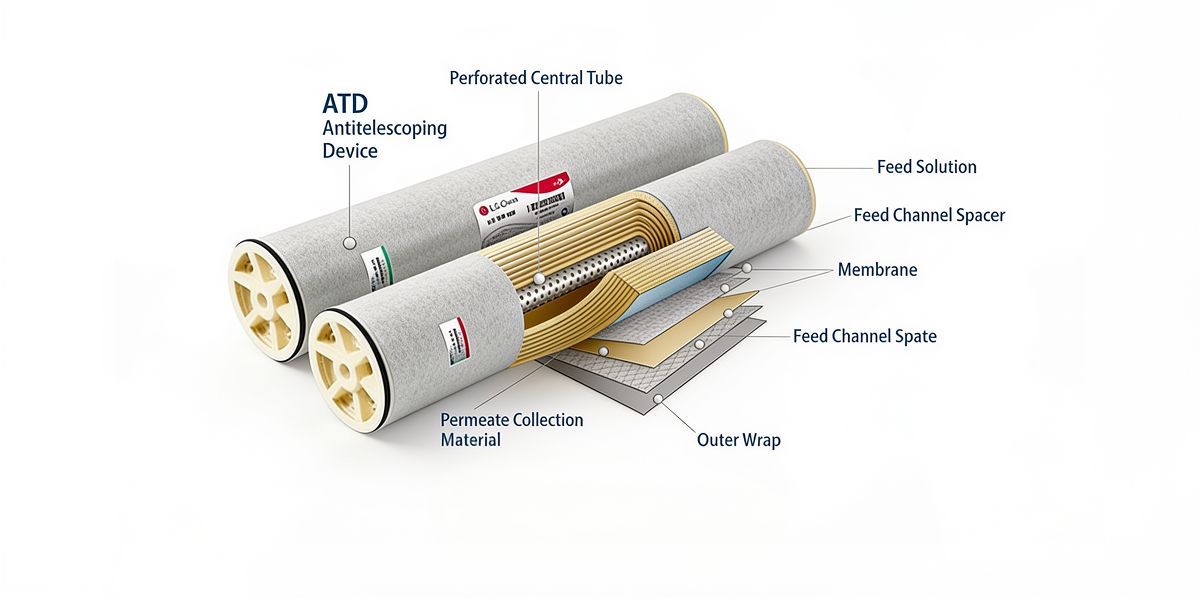
Reverse osmosis systems have become the most common water purification method because each system depends on a core component that serves as its reverse osmosis Membranes.
The effectiveness of reliable RO membranes from suppliers in the UAE depends on your knowledge of their functional operation during the selection process.
What Is RO Membrane?
Through its semi-permeable design, an RO membrane removes dissolved mineral content while eliminating other pollutants and microorganisms from water at a molecular scale.
It does not operate like traditional filters, which only trap particles. Its ion dissociation capability makes it one of the most effective water purification processes available today.
Businesses throughout the region use solutions from industrial RO membrane suppliers for uniform and superior water production results.
What Does an reverse osmosis Membrane Remove?
- Dissolved salts and Total Dissolved Solids (TDS)
- Heavy metals such as lead, arsenic, and mercury
- Bacteria and harmful microorganisms
- Organic chemicals and pesticides
- Nitrates, sulfates, and silica
- Fine suspended particles

This purification stage is essential for industrial operations that depend on steady and consistent water quality.
How Does Reverse Osmosis Membrane Work?
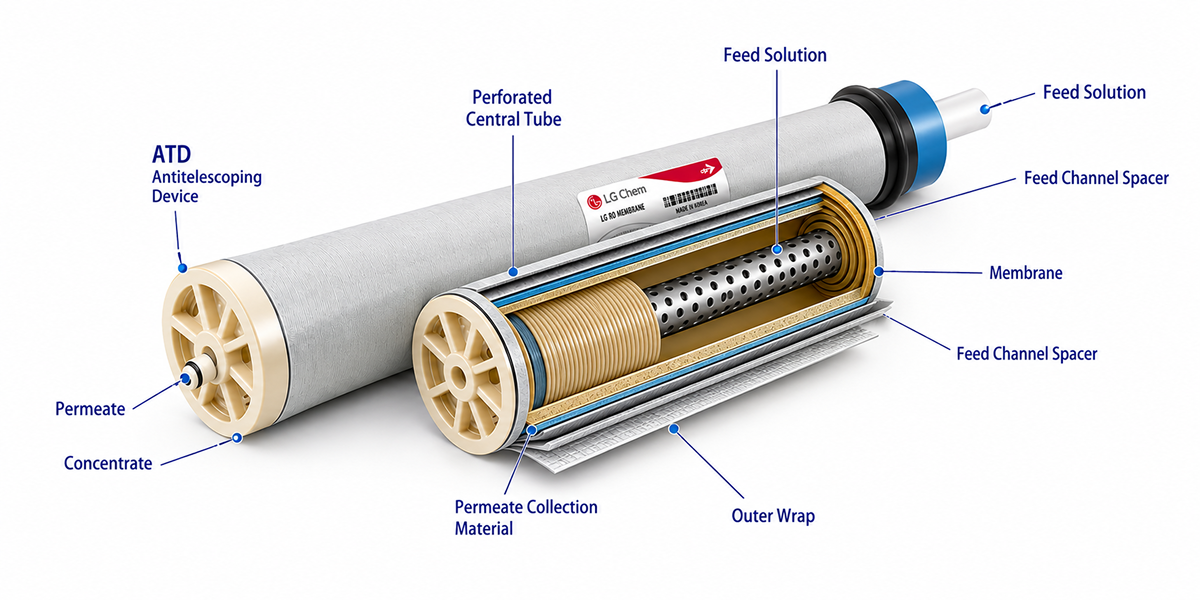
Membrane-based reverse osmosis works by moving pressurized water through semi-permeable membrane layers.
Osmosis has been reversed because water travels in the opposite direction during this process to achieve purification. The membrane allows clean water molecules to flow through while keeping contaminants behind.
The RO Process in Simple Steps
Raw Water Enters the System
The reverse osmosis process begins when untreated water enters the system.
Pretreatment Removes Contaminants
Pretreatment removes:
- Chlorine
- Sediments
- Scaling agents
High-Pressure Pump Increases Pressure
A high-pressure pump raises water pressure to the required operating level.
Water Passes Through the RO Membrane
Pressurized water is forced through the semi-permeable membrane.
Clean Water and Reject Water Are Separated
The membrane separates purified water from rejected contaminants.
What pretreatment and system design protect — and what they cannot replace
Pretreatment and correct system design protect the membrane, but they do not replace the need for the right membrane size, material, and supplier for your application.

Proper pretreatment and design help address
- Chlorine before it reaches chlorine-sensitive TFC membranes
- Sediments that would otherwise load the membrane surface
- Scaling agents that threaten long-term performance
- Inefficient operating setpoints through professional system design

Pretreatment alone cannot replace
- Choosing the wrong membrane size (for example, 4040 vs 8040 capacity needs)
- Skipping membrane selection based on application requirements
- Ignoring feed water quality, pressure, temperature, and recovery limits
- Expecting a traditional particle filter to deliver molecular-level RO rejection
Aqua Flair Trading LLC supplies water treatment equipment in the UAE and supports membrane selection, installation, maintenance, and performance optimization.
Getting more life and value from your RO membrane
Membrane longevity and system efficiency improve when selection, pretreatment, and operating discipline work together:
- Specify the right membrane for the job— 4040 membranes suit smaller commercial systems, while 8040 membranes serve larger industrial capacity needs
- Protect TFC membranes from chlorinewith pretreatment that removes chlorine before contact
- Control feed quality, pressure, temperature, and recoveryso the membrane operates within an efficient envelope
- Use pretreatment for sediments and scaling agentsbefore pressurized water reaches the membrane
- Work with a supplier that supports selection and upkeepincluding guidance, installation, maintenance, and troubleshooting

In the UAE, RO membranes support desalination, industrial water reuse, commercial supply, and reduced pressure on traditional water sources — when systems are specified and protected correctly.
Frequently Asked Questions
RO membranes filter molecular-level contaminants, while standard filters mainly block larger particles and sediments.
Yes. Reverse osmosis membrane technology can remove bacteria and many viruses. Proper pretreatment and disinfection remain essential.
Permeate is the purified water that passes through the reverse osmosis membrane after treatment.
Concentrate is the reject stream containing impurities removed during the reverse osmosis process.
4040 membranes are commonly used in smaller commercial systems, while 8040 membranes are designed for larger industrial applications that need higher capacity.
Conclusion
Every reverse osmosis system relies on its core RO membrane. Industries that need reliable water quality depend on membranes that remove dissolved salts, contaminants, and microorganisms with high efficiency.
Success also depends on choosing the right RO membrane supplier in the UAE. A trusted partner provides quality products and helps sustain long-term performance, operational reliability, and cost-effective treatment.
Share this story


