


Introduction
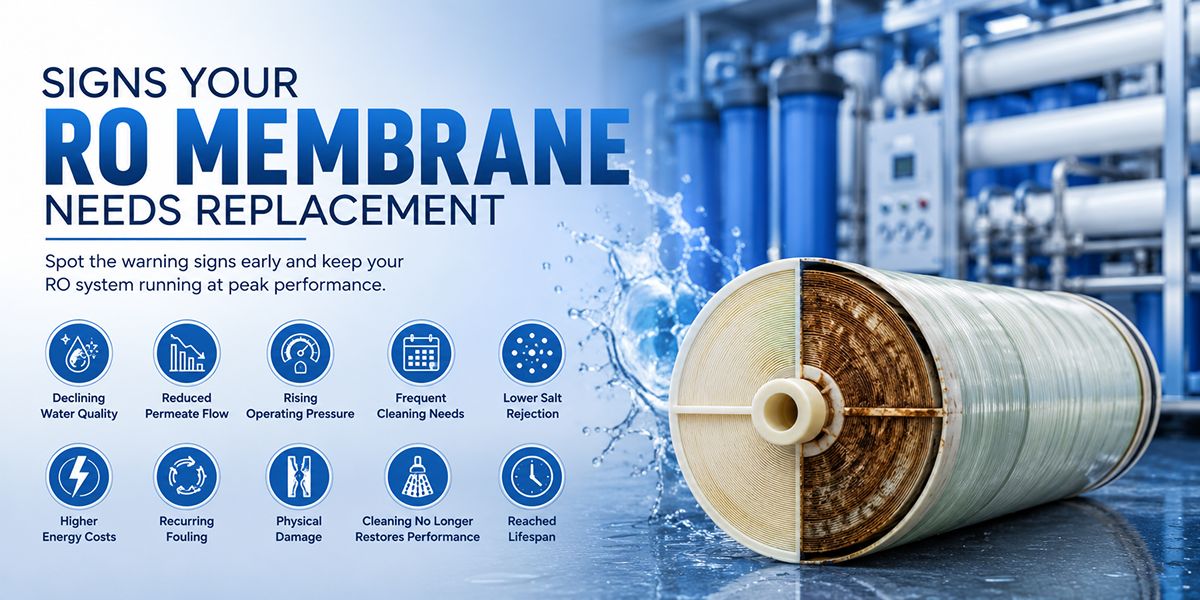
Every reverse osmosis (RO) system lives or dies by one part: the membrane. It turns raw feed water into clean, usable output, and while a good RO membrane is built to perform for years, it is not built to last forever. Constant exposure to dissolved salts, minerals, suspended solids and microorganisms wears it down gradually, until one day the numbers on your dashboard no longer add up.
Plant operators ask the same question all the time: how do I know when it is time to replace the RO membrane? There is no single answer. A drop in output or water quality could point to fouling, scaling, an operating problem or simply old age.
Replace too soon and you waste budget on a membrane that still had life left. Wait too long and you risk falling production, climbing energy bills and water that no longer meets specification. Knowing the warning signs early lets you plan replacement on your terms instead of reacting to a breakdown.
This article walks through the ten clearest indicators that an industrial RO membrane is nearing the end of its life, what causes early wear and how to stretch membrane life as far as possible. For the full picture of types, fouling, cleaning and selection, read our Complete Guide to RO Membranes. If you are new to the technology, start with What Is an RO Membrane and How Does It Work?
Why Timely Replacement Matters
The membrane determines how well your system rejects dissolved contaminants, which means it determines the quality of everything downstream. Once performance starts slipping, the whole system feels it: pressure creeps up, permeate flow drops, TDS rises and the pump works harder for less output.
Replacing a membrane at the right moment protects:
- Consistent water quality
- Stable production capacity
- Lower day-to-day operating costs
- Energy efficiency
- The life of pumps and downstream equipment
- Overall process reliability
For sectors where water purity is not optional, such as food and beverage processing, pharmaceuticals, manufacturing and hospitality, staying ahead of replacement is part of basic operational discipline.
How Long Does an RO Membrane Actually Last?
There is a common myth that every membrane has a fixed expiry date. In practice, industrial RO membranes typically last three to five years, and where a given unit lands in that range depends on feed water quality, the standard of your pretreatment, operating pressure, cleaning habits and general system upkeep.
Two identical membranes can age at very different rates depending on how well the system around them is run. Age alone is not a reliable trigger. Performance monitoring is.
How to Spot Decline Early: Normalise Your Data
Raw readings mislead, because flow and salt passage change with temperature and feed pressure. Compare normalised permeate flow, salt rejection and differential pressure against the baseline recorded in the first days of operation. A flow meter on the feed, permeate and concentrate lines and water quality meters for conductivity, TDS and pH give you the numbers. A sustained change of roughly 10 to 15% from baseline is the usual trigger to investigate.
10 Warning Signs You Should Not Ignore
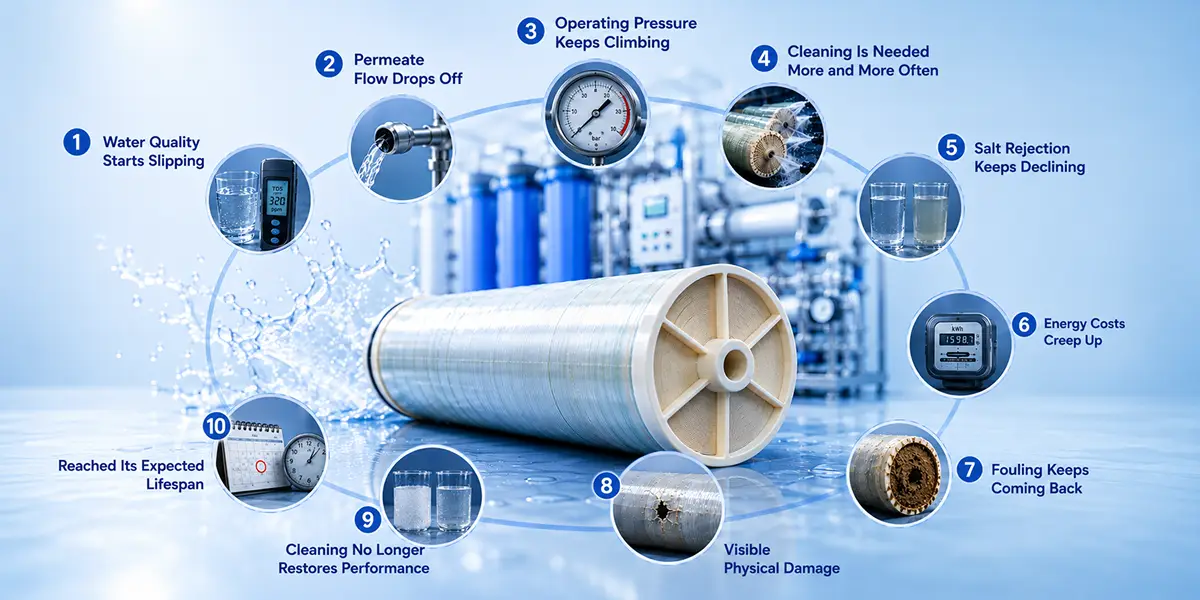
1. Water quality starts slipping
A membrane’s job is to reject dissolved salts at a high, consistent rate. As it ages or sustains damage, that rejection declines. It shows up as rising TDS, higher conductivity and product water that is not as clean as it used to be. If a cleaning cycle does not bring rejection back, the membrane has likely reached its limit.
2. Permeate flow drops off
When output falls even though feed pressure has not changed, that is a red flag. You will notice slower production, longer running times to reach the same volume, or a system that cannot keep pace with demand. Fouling can cause temporary dips, but a permanent decline usually means it is time to consider replacement.
3. Operating pressure keeps climbing
Rising differential pressure across the membrane is one of the most dependable signs of fouling or wear. As contaminants build up on the surface, the system needs more force to keep production steady. It often points to scaling, biological growth, organic build-up or physical blockage. If cleaning no longer brings pressure back to normal, replacement is the next step.
4. Cleaning is needed more and more often
Routine chemical cleaning is a normal maintenance task. But if the interval between cleanings keeps shrinking without any real payoff, that is a signal of irreversible wear. At some point, a membrane that needs constant intervention costs more to keep than to replace.
5. Salt rejection keeps declining
Consistent, ongoing loss of rejection usually points to age, chemical damage, oxidation or breakdown of the membrane surface. These are not problems a cleaning cycle can fix. A sudden jump after a chlorine event is a classic sign of oxidation. This directly threatens your ability to meet process water specifications.
6. Energy costs creep up
This one is easy to miss because it does not look like a water quality problem. As a membrane fouls, scales or ages, the system needs more pressure to hold the same flow, so the pump works harder and draws more power. Watch for rising energy use without a matching rise in output, or a pump running longer than usual. Tracked over months, that extra expense can outweigh the cost of a new membrane.
7. Fouling keeps coming back
Some fouling is expected over the life of any membrane. But when it returns shortly after every cleaning, the membrane has usually hit the limit of what cleaning can fix. The common culprits are:
- Mineral scaling: calcium carbonate, calcium sulphate and silica building up on the surface
- Organic fouling: oils and organic matter clogging membrane pores
- Biological fouling: bacteria, algae or biofilm, often linked to weak pretreatment
- Colloidal fouling: fine suspended particles raising pressure drop over time
If fouling is recurring, look upstream as well. Weak bag filters, exhausted filtration media or a worn cartridge filter will keep feeding the membrane contaminants.
8. Visible physical damage
Not every failure is gradual. A routine inspection might find torn membrane sheets, cracked elements, damaged end caps, broken brine seals or warped spacers. These are usually the result of pressure spikes, mishandling, chemical attack or poor installation. Check the RO pressure vessel seals and adapters at the same time. Once there is structural damage, no cleaning process will fix it, and replacement is the only real option.
9. Cleaning no longer restores performance
This is often the clearest sign of all. If a professional cleaning cycle fails to improve production, salt rejection or differential pressure, the membrane has likely aged past the point of recovery. Continuing to run it just adds cost while output keeps sliding.
10. It has simply reached its expected lifespan
Even a membrane that seems to be performing fine deserves attention as it approaches the three-to-five-year mark. As it nears end of life, step up your monitoring and plan a scheduled swap. A planned replacement is almost always cheaper than an unplanned shutdown.
Before You Replace: Rule Out Other Causes
Low output is not always a membrane problem. Check these first so you do not replace a healthy element:
- Pretreatment: blocked pre-filters, exhausted media or carbon, or a dosing fault.
- Feed conditions: low feed pressure, a change in feed temperature or salinity, or a new water source.
- Pump and instruments: a worn high-pressure pump or a drifting gauge or sensor.
- Antiscalant dosing: an under-dosing pump will cause scaling that looks like membrane failure. Reliable dosing pumps keep the dose stable.
Can Cleaning Save a Failing Membrane?
It depends entirely on the root cause.
Cleaning can fix
- Mineral scaling
- Organic fouling
- Biological contamination
- Colloidal build-up
Cleaning cannot fix
- Natural membrane ageing
- Chemical oxidation
- Mechanical or structural damage
- Torn membrane sheets
- Permanent rejection loss
Knowing which category you are dealing with saves you from spending on cleanings that were never going to solve the problem.
Choosing the Replacement
When replacement is confirmed, match the new element to the original duty: brackish or seawater, 4040 or 8040, and the flow and rejection your design needs. Browse FilmTec, Hydranautics and LG elements in our RO membrane range. For a buyer’s comparison, read Wholesale RO Membranes in UAE: Filmtec, LG and Hydranautics.
Replace elements across a full stage together where possible, because mixing very old and new elements gives uneven flux. Where budget is tight and the duty is not critical, refurbished and used RO membranes are an option, with shorter expected life. If the whole plant is ageing, a new RO system may be more economical than another membrane change.
Getting More Life Out of Your Membrane
Every membrane eventually needs replacing, but good operating practice can push that timeline out considerably:
- Invest in real pretreatment to strip out suspended solids, chlorine and other stressors before they reach the membrane. How Water Treatment Systems Work shows the full train.
- Track performance data, including TDS, conductivity and rejection rate, so problems surface early.
- Clean based on data, not the calendar.
- Stay within the manufacturer’s pressure range.
- Dose antiscalants correctly to keep mineral scaling in check.
- Follow the manufacturer’s operating guidelines to the letter.
Preventive care is consistently cheaper than emergency replacement.
Frequently Asked Questions
How often should an industrial RO membrane be replaced?
Most last three to five years, though the real number depends on operating conditions and how well the system is maintained.
Can a membrane fail without visible damage?
Yes. Internal performance loss often happens well before any physical sign appears.
Is low water production always a membrane problem?
Not necessarily. Fouling, weak feed pressure, blocked pre-filters or pump issues can all cause the same symptom. A full system check should always come before you replace the membrane.
Does cleaning restore original performance?
It can clear fouling and scaling, but it cannot reverse ageing or repair physical damage.
What happens if a worn membrane stays in service?
Expect declining water quality, higher energy bills, reduced output, faster equipment wear and a greater risk of unplanned downtime.
Conclusion
Catching the signs of a failing RO membrane early is what keeps water quality consistent, protects your equipment and controls long-term operating costs. Falling permeate flow, rising pressure, weaker salt rejection, more frequent cleaning, higher energy use and recurring fouling are all signals worth acting on, not ignoring.
Good pretreatment and disciplined maintenance can extend a membrane’s working life significantly, but every membrane eventually reaches its limit. Replacing it at the right time, not too early and not too late, keeps your system running efficiently.
If you are sourcing RO membrane suppliers in the UAE or dependable water treatment equipment, Aqua Flair Trading LLC supplies industrial RO membranes, replacement parts and complete water treatment solutions across the UAE and GCC. Request a quote with your system details and our team will recommend the right replacement.
Share this story


