


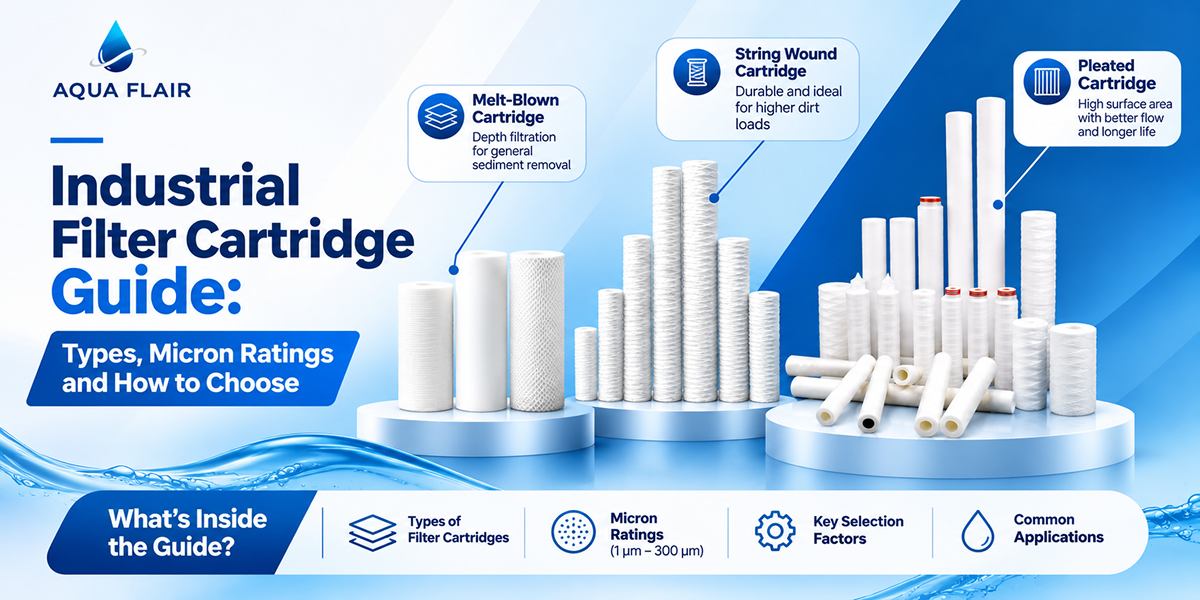
An industrial filter cartridge is a replaceable element that sits inside a housing and removes particles from water or process liquid as it passes through. To choose one, match five things: the cartridge type (string wound, melt blown or pleated), the micron rating, the material, the size that fits your housing, and the flow rate the system must carry. Get these right and the cartridge protects pumps, RO membranes and process equipment. Get them wrong and it clogs early, bypasses dirt or costs more than it saves.
Key Takeaways
- Cartridges work by depth filtration (dirt is held through the wall) or surface filtration (dirt stays on the pleated face). The type you need depends on how dirty the water is.
- A nominal micron rating is an average. An absolute rating is a guaranteed cut-off. Use the absolute rating where a single oversize particle can do damage.
- Finer is not always better. A cartridge that is too fine for the water blocks in days.
- The cartridge must match the housing in length, diameter and seal style, or unfiltered water will pass around it.
What Is an Industrial Filter Cartridge?
A filter cartridge is a hollow cylinder, usually 2.5 inches in diameter and 10 to 40 inches long. Water enters through the outside wall, passes through the filter material and leaves through the open centre. The housing holds the cartridge in place and keeps the flow forced through it.
Industrial duty means higher flows, longer running hours and failures that can stop a line or damage costly equipment, so selection needs more care than picking the first cartridge that fits.
How Filter Cartridges Work
Depth filtration. The wall is thick and holds particles throughout its thickness, with coarse layers on the outside and finer ones inside. It carries a high dirt load and suits water with a lot of mixed solids.
Surface filtration. A folded sheet of media traps particles on its face. Pleating packs a large area into a small body, which gives low pressure drop and a fine, sharp cut-off.
Types of Industrial Filter Cartridge
|
Type |
How it works |
Best for |
Watch out for |
|
String wound |
Yarn wound onto a core in graded layers |
General sediment, high dirt load, good value |
Fibre can shed if poorly made, and the rating is nominal |
|
Melt blown |
Fine fibres bonded into a graded-density tube |
Sediment and fine solids, steady quality |
Less surface area than pleated |
|
Pleated |
Folded media on a core |
Fine or absolute filtration, long life, low pressure drop |
Higher unit cost, and heavy mud loads can clog the folds |
|
High flow |
Large-diameter pleated cartridge |
Big flows in a small housing |
Needs a matching housing |
String wound sediment cartridges
Yarn is wound in layers, tight on the inside and looser on the outside. The result traps large particles first and fine ones deeper in the wall. Aqua Flair lists a string wound sediment cartridges in our range in the 2.5-inch diameter range, suitable as a first-stage filter ahead of finer elements.
Melt blown sediment cartridges
Fine polymer fibres are blown and bonded into a tube whose density grows toward the core. This gives a consistent structure and a dependable rating. See our spun melt blown cartridge range range, including the 2.5-inch melt blown spun listing listing.
Pleated cartridges
Pleating gives many times the surface area of a wound cartridge of the same size, so flow is easier and life is longer in clean-to-moderate water. Browse our pleated cartridge collection, including the DOE pleated cartridge and the FIN pleated cartridge. Our guide to choosing pleated filter media explains the media choices.
High-flow cartridges
A high-flow cartridge is wider than a standard one and carries large flow through a single element. It cuts the number of cartridges and the size of the housing. Our high-flow cartridge systems range and the article how high-flow pleated designs work cover where they fit.
Understanding Micron Ratings
A micron (µm) is one millionth of a metre. A human hair is roughly 70 microns wide. Common cartridge ratings run from 1 to 50 microns.
- Nominal rating. The cartridge removes a stated percentage of particles at that size, often around 85 to 90 percent. Larger particles can still get through.
- Absolute rating. The cartridge removes nearly all particles at or above the stated size, usually verified by a beta ratio test. A beta ratio of 5,000, for example, means 99.98 percent removal at that size.
Use a nominal rating for general sediment control. Use an absolute rating ahead of RO membranes, dosing equipment or any process where one oversize particle matters.
|
Micron rating |
Typical use |
|
50 to 20 |
Coarse prefiltration, protecting finer stages |
|
10 |
General sediment removal, softener and carbon protection |
|
5 |
Final guard before RO membranes and pumps |
|
1 |
Fine polishing where clarity matters |
Use staged filtration: a coarse cartridge first and a fine one second. The coarse stage takes the bulk of the dirt, so the fine cartridge lasts far longer.
Choosing the Material
- Polypropylene is the standard for water. It resists most chemicals, does not rot and is widely available.
- Polyester and nylon pleated media give fine, consistent filtration in clean water.
- Stainless steel and special polymers suit aggressive fluids or high temperatures.
Check the temperature and chemical limit of the material against your duty. If the fluid is hot, chlorinated at high levels or carries solvents, confirm the cartridge material before ordering.
Sizes and Housing Fit
Standard lengths are 10, 20, 30 and 40 inches, usually in a 2.5-inch diameter. Length matters because a longer cartridge has more surface area, so it carries more flow and lasts longer.
Before ordering, confirm:
- Length and diameter match the housing.
- End style (open end, double open end, with or without gasket) matches the housing seal.
- Cartridge count matches the flow you need.
For a single line, a housing from our cartridge filtration range holds one or a few cartridges. For high flow, use a cluster housing that holds many together. Aqua Flair lists stainless steel cluster housings, UPVC cluster housing options and FRP cluster housing options. Our SS304 versus SS316L housing advice and how housings fit a filtration line help you compare them.
How to Choose the Right Cartridge: Step by Step
- Know the water. Get the turbidity, suspended solids and any oil, iron or algae. A simple lab test avoids guesswork.
- Define the job. Is the cartridge a pre-filter, a final guard or a polishing stage? That sets the micron rating.
- Pick the type. Heavy dirt favours string wound or melt blown. Fine, clean duties favour pleated.
- Set the rating. Choose absolute where failure is costly, nominal where it is not.
- Check flow and pressure drop. Use enough cartridges that each one works well below its maximum flow. As a rough guide, a 20-inch cartridge handles about 2 m³/h, and longer ones scale up.
- Confirm material and temperature.
- Match the housing, then plan spares.
Worked Example: Sizing Cartridges for a 12 m³/h Line
Take an RO pretreatment line that must pass 12 m³/h ahead of the membranes.
- Add a margin. Design for 25 percent above the duty to allow for fouling: 12 × 1.25 = 15 m³/h.
- Use a safe flow per cartridge. At roughly 4 m³/h for a 40-inch element, 15 ÷ 4 gives 3.75, so you need at least 4 cartridges.
- Round up to the housing. A five-cartridge housing gives headroom and keeps each element working below its limit, which stretches the change interval.
- Pick the rating. Use a 5-micron absolute cartridge as the final guard, with a coarser 20 to 50 micron stage upstream.
The same flow through only two cartridges would double the load on each one. Pressure drop would climb quickly, and the cartridges would need changing far more often.
Conditions in the UAE That Affect Cartridge Choice
- Fine dust and sand. Blown sand and dust reach tanks and open supply lines, so a coarse first stage pays off.
- Warm water. Summer feed water can be much warmer than the rated test conditions. Check the material temperature limit.
- Brackish and seawater duties. Chloride attacks poor housing materials, so pair cartridges with a corrosion-resistant housing.
Where Industrial Filter Cartridges Are Used
|
Application |
Cartridge role |
|
RO and desalination plants |
Final 5-micron guard before the high-pressure pump and membranes |
|
Food and beverage |
Particle removal in process water and rinse water |
|
Oil and gas |
Fine polishing of injection, boiler and utility water |
|
Hospitality and commercial buildings |
Sediment protection for softeners, carbon filters and heaters |
|
Manufacturing |
Process water, cooling water and wash water |
|
Chemical dosing lines |
Protecting pumps, injectors and nozzles from debris |
Cartridges rarely work alone. In a typical train they sit after media filters and before reverse osmosis membrane range, where they stop what the earlier stages missed. See how a full treatment train fits together for the full picture, and a deeper look at RO membranes for what the cartridge is protecting.
Installation Best Practice
- Flush the line first, and check the O-ring and seal are clean and undamaged.
- Fit pressure gauges before and after the housing to read pressure drop.
- Add a drain, a vent and isolation valves so the housing opens safely.
When to Replace a Cartridge
Do not wait for a fixed date. Replace the cartridge when:
- Differential pressure rises about 1 bar (15 psi) above the clean value, or reaches the limit set by the supplier.
- Flow drops and the downstream pump struggles.
- Water quality worsens after the housing.
Do not wash and reuse disposable cartridges. Dirt trapped deep in the wall does not come out.
Getting More from Your Filtration Train
- Use bag filter options first for heavy solids, then cartridges for fine, consistent filtration.
- Measure the flow with a inline flow measurement so you know the real load on each cartridge.
- Check treated water with TDS and pH testing instruments.
- Use corrosion-resistant FRP media vessels with sand and media beds ahead of the cartridges to take the heavy solids.
- Add carbon media for chlorine removal where chlorine or organics need removing.
- For microbial control after filtration, read about UV disinfection after filtration.
Supplying Filter Cartridges Across the Region
From Dubai, Aqua Flair supplies cartridge filters to the UAE and to customers in the countries below.
|
Country |
Cartridge filters page |
|
Saudi Arabia |
|
|
Qatar |
|
|
Oman |
|
|
Kuwait |
|
|
Bahrain |
|
|
Kenya |
|
|
Angola |
|
|
Rwanda |
Delivery time outside the UAE depends on the destination and items ordered, and we confirm it in the quotation.
Conclusion
The right filter cartridge protects every stage behind it. Choose the type to suit the dirt load, set the micron rating for the job, match the material and size to the housing, and change the element on pressure drop. Staged filtration, correct sizing and good spares keep running costs low.
As a water treatment equipment supplier in the UAE, Aqua Flair Trading LLC helps you match cartridges, housings and pretreatment as one system. To specify yours, send us your flow rate and micron target along with the housing size. Get to know the team behind Aqua Flair or browse our complete water treatment catalogue.
Frequently Asked Questions
What is an industrial filter cartridge?
It is a replaceable element, usually 2.5 inches wide and 10 to 40 inches long, that fits inside a housing and removes particles as water passes through its wall.
What micron rating should I choose?
Use 5 microns as a final guard before RO membranes, 10 microns for general sediment, and 20 to 50 microns for coarse prefiltration. Use an absolute rating where one oversize particle can cause damage.
What is the difference between nominal and absolute rating?
A nominal rating removes a stated share of particles at that size, so some larger ones still pass. An absolute rating removes nearly all particles at or above the size, verified by a beta ratio test.
Which is better, pleated or string wound?
Pleated gives finer filtration and lower pressure drop in clean to moderate water. String wound gives more dirt capacity in heavy-solids water at a lower cost. Many plants use both, coarse first and fine second.
How often should I change filter cartridges?
Change them when differential pressure rises about 1 bar above the clean reading, when flow drops, or when water quality falls. Dirty water can need a change in days, while clean water can run for months.
Can I wash and reuse a cartridge?
Standard wound, melt blown and pleated cartridges are made to be replaced. Cleaning rarely removes dirt from deep in the media, so replacement is the safe choice.
Do I need a cartridge filter before an RO system?
Yes, in most designs. A 5-micron cartridge stage is the usual last guard before the high-pressure pump and membranes, because it catches fine particles that earlier stages miss.
Can I use a bag filter instead of a cartridge?
Bag filters suit heavy solids and coarse protection. Cartridges give finer, more consistent filtration, so many plants fit a bag filter first and a cartridge second.
Share this story


