


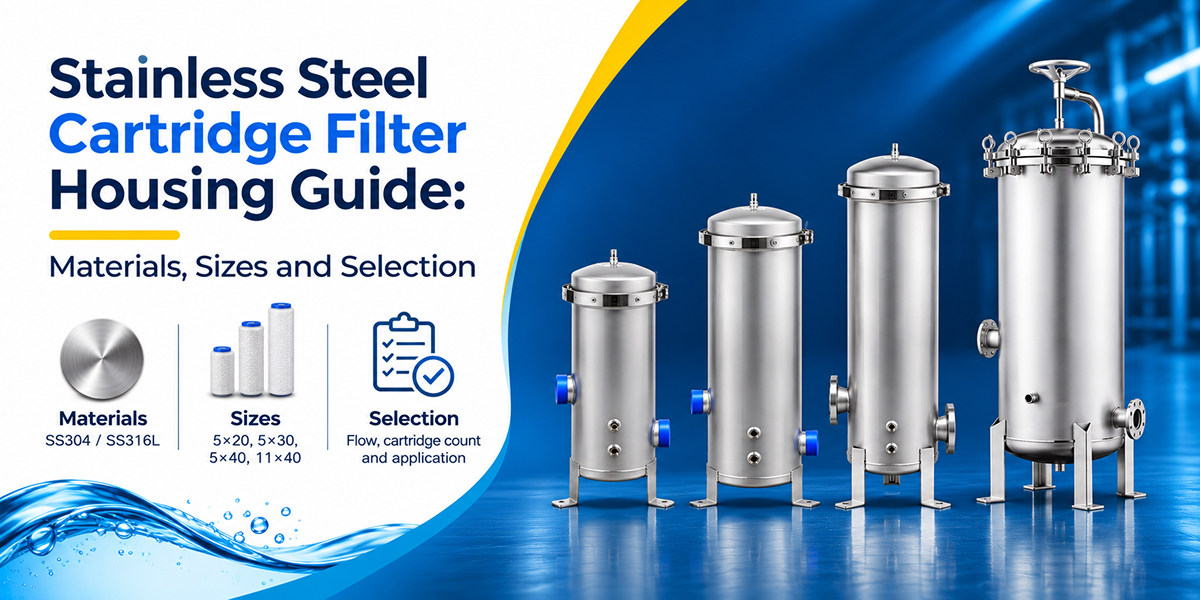
A stainless steel cluster filter housing is a pressure vessel that holds several cartridge filters side by side inside one body. It suits industrial and commercial plants that need more flow than a single-cartridge housing can give, in a compact footprint. To choose one, match four things: the body material (SS304 or SS316L), the size (cartridge count and length, such as 5x20 or 11x40), the flow and pressure you need, and the cartridge type that fits the water. Aqua Flair lists four models, from the 5x20 for up to 10 m³/h to the 11x40 for up to 45 m³/h.
Key Takeaways
- A cluster housing spreads the flow across several cartridges, so each cartridge works at a lower flow and lasts longer between changes.
- SS316L resists chlorides better than SS304, so it is the safer choice for salty, brackish or chlorinated water.
- The model name tells you the layout: 5x20 means five cartridges of 20 inches, and 11x40 means eleven cartridges of 40 inches.
- Check the housing’s pressure limit, not just its flow. The 5-cartridge models are listed at 6 bar and the 11x40 at 10 bar.
- Stainless steel costs more than plastic or FRP housings, so it makes the most sense where strength, hygiene or heat tolerance matter.
What Is a Cluster Filter Housing?
A cluster housing is a single stainless steel vessel with a tube sheet or plate inside. Several cartridge filters stand on that plate, and the water passes through all of them in parallel. Dirty water enters on one side, flows through the cartridges from outside to inside, and leaves clean on the other side.
Compare this with a single-cartridge housing. If you need ten times the flow, you would need ten housings, ten sets of pipe connections and a large frame. A cluster housing puts that capacity into one body. That saves floor space, reduces pipework and makes cartridge changes a single job instead of ten.
Aqua Flair supplies stainless steel cluster filter housings for water treatment, RO pre-filtration, food and beverage, chemical and general industrial use. For a wider look at all housing types, read Filter Housings in Water Filtration Systems.
Why Choose Stainless Steel?
Stainless steel is not the cheapest housing material, so choose it for a reason. It makes sense when you need:
- Strength under pressure. The metal body handles higher working pressure and pressure swings with less risk of fatigue.
- Hygienic surfaces. The smooth, non-porous metal is easy to clean, which matters in food, beverage and pharmaceutical duties.
- Temperature tolerance. Metal copes with warm or hot liquids better than most plastics. Confirm the limit for your model and seals.
- A long working life. A well-chosen grade can run for many years with routine seal replacement.
- Impact and sun resistance. It does not crack from knocks and is not affected by UV light, which helps on outdoor skids.
If you do not need those things, a lighter housing may do. Compare it with FRP cluster housings and UPVC cluster housings before you decide.
SS304 vs SS316L: Which Grade Do You Need?
Both grades are austenitic stainless steels, and both resist rust in ordinary water. The difference is that SS316L contains molybdenum, which improves resistance to pitting and crevice corrosion from chlorides. The “L” means low carbon, which helps welds resist corrosion.
|
|
SS304 |
SS316L |
|
Chloride resistance |
Moderate |
Better |
|
Best for |
Fresh water, clean process water, general industrial duty |
Brackish water, chlorinated water, coastal sites, chemical duty |
|
Cost |
Lower |
Higher |
|
Risk to watch |
Pitting in salty or chlorinated water |
Still pits in very high chloride or stagnant conditions |
A simple rule: if your water has a TDS above a few thousand mg/L, contains noticeable chloride or chlorine, or the plant sits near the coast, choose SS316L. If the water is clean municipal or treated process water, SS304 can be enough. Many UAE sites are coastal, where salty air and water raise the chloride load, so SS316L is the safer default there. Aqua Flair lists both grades, so state which one you need when you request a quote.
No stainless grade is immune. Standing chlorinated water, salt deposits and aggressive cleaners can all cause pitting, even on SS316L. The care section below covers how to avoid it.
Sizes and Specifications
The four models in the range use the same cartridge diameter of 2.5 inches and differ by cartridge count and length. These figures are the listed values on each product page. Always confirm the exact specification for your model before ordering.
|
Model |
Cartridges |
Cartridge length |
Flow (listed) |
Max pressure |
|
5 |
20 in |
0 to 10 m³/h |
6 bar (100 psi) |
|
|
5 |
30 in |
0 to 15 m³/h |
6 bar (100 psi) |
|
|
5 |
40 in |
0 to 20 m³/h |
6 bar (100 psi) |
|
|
11 |
40 in |
0 to 45 m³/h |
10 bar (150 psi) |
Read the table like this: a longer cartridge has more filtration area, so the same five-cartridge layout passes more flow. Dividing the listed maximum flow by the number of cartridges gives about 2 m³/h per 20-inch cartridge, 3 m³/h per 30-inch cartridge and 4 m³/h per 40-inch cartridge. The 11x40 comes out at roughly 4 m³/h per cartridge as well. That is a handy way to check a size, but treat the figure as an upper limit. Real flow depends on the cartridge micron rating, the water quality and the pressure drop you can accept.
How to Choose the Right Housing: Step by Step
1. Set your design flow. Use the real peak flow in m³/h, not the pump’s maximum.
2. Leave headroom. Aim to run below the listed maximum. A housing sized at 60 to 70 percent of its maximum flow gives longer cartridge life and a lower pressure drop.
3. Pick the micron rating. Choose the particle size you need to remove. Finer ratings clog faster, so use a coarser cartridge upstream if the water is dirty.
4. Check the pressure. Compare the working pressure of your system, including surges, with the housing rating. For RO feed lines, the housing sits before the high-pressure pump, so 6 or 10 bar is usually enough.
5. Choose the grade. Use SS316L for chloride-rich or coastal duty, and SS304 for clean, low-chloride water.
6. Match the connections. Confirm the inlet and outlet size and type with your pipework. The product pages note that connection options can be configured.
7. Plan for space. Allow room above the housing to lift out the cartridges. A 40-inch cartridge needs more headroom than a 20-inch one.
8. Check the seals. Choose an O-ring material that suits your fluid, temperature and any cleaning chemicals.
Worked example: you need to filter 18 m³/h of treated water ahead of an RO system. The 5x30 tops out at 15 m³/h, so it is too small. The 5x40 lists up to 20 m³/h, but 18 m³/h is 90 percent of its maximum, which leaves little margin. The 11x40 gives you ample headroom and a long cartridge life, or you could run two 5x40 units in parallel at 9 m³/h each. Your decision depends on space, budget and how often you can stop for cartridge changes.
Choosing the Cartridges
The housing is only half the system. The cartridges do the filtering, and the right type depends on the job:
- Spun melt-blown polypropylene cartridges give depth filtration for general sediment. See the melt-blown sediment filters.
- String-wound cartridges suit higher dirt loads and a wider range of chemical duties. See the string-wound filters.
- Pleated cartridges give finer filtration with a larger surface area and a longer life. See the pleated filter cartridges and the guide Pleated Filter Cartridges: Media Options.
Always check that the cartridge length and diameter match the housing. For the full cartridge range, browse the cartridge filter category. If your flow is very large, a high flow filter may replace a cluster of many small cartridges. Read High Flow Pleated Filter Cartridges to compare the two.
Where Stainless Cluster Housings Are Used
|
Application |
Role of the housing |
|
RO pre-treatment |
Removes sediment and fine particles before the RO feed pump, protecting RO membranes and RO systems |
|
Industrial water treatment |
Filters process and utility water to protect pumps, heat exchangers and valves |
|
Food and beverage |
Polishes compatible process water and liquids on hygienic duties |
|
Pharmaceutical and chemical |
Filters compatible liquids where the body must resist the chemistry |
|
Commercial buildings |
Central filtration for hotels, hospitals and large sites |
|
Municipal and power |
Pre-filtration and clarification ahead of sensitive equipment |
For where a housing sits in a full plant, read How Water Treatment Systems Work and the Industrial RO Pressure Vessel Guide.
Installation Best Practice
- Mount on a level, rigid base and support the pipework so its weight does not load the housing nozzles.
- Fit isolation valves on the inlet and outlet, plus a bypass if the process cannot stop. Fit a drain at the lowest point and a vent at the highest.
- Add pressure gauges before and after the housing. The pressure difference tells you when to change cartridges.
- Check the cartridge seating and O-ring before closing the lid. A cartridge that sits crooked will leak unfiltered water past the seal.
- Fill slowly and vent air before bringing the housing up to full pressure.
- Record the clean differential pressure on day one so you have a baseline.
Maintenance and Care
- Change cartridges on differential pressure, not just time. Replace them when the pressure drop reaches the limit you set, which is often 1 bar above the clean reading.
- Replace the lid O-ring at each service, and lubricate it only with a compatible lubricant.
- Inspect the lid, clamps and tube sheet for wear, deposits or discolouration.
- Do not leave chlorinated or salty water standing in the housing. Drain and flush it if the plant will be idle for a long time.
- Avoid hydrochloric acid and strong chlorine cleaners on the stainless steel. They can cause pitting. Use cleaners approved for the grade you have.
- Keep spare cartridges and O-rings on site for fast changes.
- Verify the result. Check the filtered water with water quality meters and track the flow with a flow meter.
Common Problems and Causes
|
Symptom |
Likely cause |
Action |
|
Fast pressure rise |
Cartridge too fine, or dirty feed |
Use a coarser cartridge upstream, or add a bag filter first |
|
Leak at the lid |
Dry, damaged or wrongly seated O-ring |
Replace and re-seat the seal |
|
Unfiltered particles downstream |
Cartridge not seated, or damaged cartridge |
Reseat or replace the cartridge |
|
Rust spots or pitting |
Chlorides or stagnant chlorinated water on SS304 |
Move to SS316L and avoid standing water |
|
Low flow |
Blocked cartridges or an undersized housing |
Check differential pressure and compare with the model’s rating |
Buying Checklist
Before you request a quote, collect:
1. Design flow in m³/h and the maximum working pressure
2. Fluid type, temperature range and any chemicals used
3. Water chlorides or TDS, to choose SS304 or SS316L
4. Required micron rating and cartridge type
5. Cartridge length and count (5x20, 5x30, 5x40 or 11x40)
6. Inlet and outlet size and connection type
7. Seal material and any special finish requirements
8. Space available for installation and cartridge removal
Supplying Projects Across the Region
If you buy for projects outside the UAE, Aqua Flair also lists stainless steel cluster filter housings for Saudi Arabia, Kuwait, Qatar, Oman and Bahrain.
Frequently Asked Questions
What is a stainless steel cluster filter housing?
It is a stainless steel pressure vessel that holds several cartridge filters in one body. The water passes through all cartridges in parallel, which gives more flow capacity in a smaller space than a single-cartridge housing.
What does 5x20 or 11x40 mean on a filter housing?
The first number is the number of cartridges and the second is the cartridge length in inches. A 5x20 holds five 20-inch cartridges, and an 11x40 holds eleven 40-inch cartridges.
What is the difference between SS304 and SS316L?
SS316L contains molybdenum, which gives it better resistance to chloride pitting than SS304. Choose SS316L for salty, brackish, chlorinated or coastal conditions, and SS304 for clean, low-chloride water.
How much flow can a stainless cluster housing handle?
Aqua Flair lists the 5x20 for up to 10 m³/h, the 5x30 for up to 15 m³/h, the 5x40 for up to 20 m³/h and the 11x40 for up to 45 m³/h. Run below the maximum for longer cartridge life.
What pressure can these housings take?
The listed maximum is 6 bar (100 psi) for the 5-cartridge models and 10 bar (150 psi) for the 11x40. Always include pressure surges when you check the rating.
When should I change the cartridges?
Change them when the pressure drop across the housing reaches the limit you set, commonly around 1 bar above the clean reading, or earlier if the filtered water quality drops. Do not wait for the flow to collapse.
Can I use a stainless housing before an RO system?
Yes. Stainless cluster housings are widely used for RO pre-filtration, where they remove particles before the high-pressure pump and membranes.
Is stainless steel better than FRP or UPVC for filter housings?
It depends on the duty. Stainless steel gives strength, hygiene and heat tolerance, while FRP and UPVC resist corrosion and cost less. Pick the material from your fluid, pressure and budget.
Where can I buy stainless steel filter housings in the UAE?
Aqua Flair Trading LLC in Dubai supplies stainless steel cluster filter housings in four sizes. Send your flow rate, pressure and water quality for a recommendation.
Conclusion
A stainless steel cluster filter housing packs a lot of filtration into a small footprint. Choose the grade from your water chemistry, choose the size from your real flow with headroom, match the cartridge to the particles, and keep the seals and cleaning routine in good order.
As a water treatment equipment supplier in the UAE, Aqua Flair Trading LLC helps you match the housing, cartridges and pre-treatment as one system. To specify your project, request a quote with your flow rate, pressure and water type. Learn more about Aqua Flair or browse the full products page.
Share this story


