


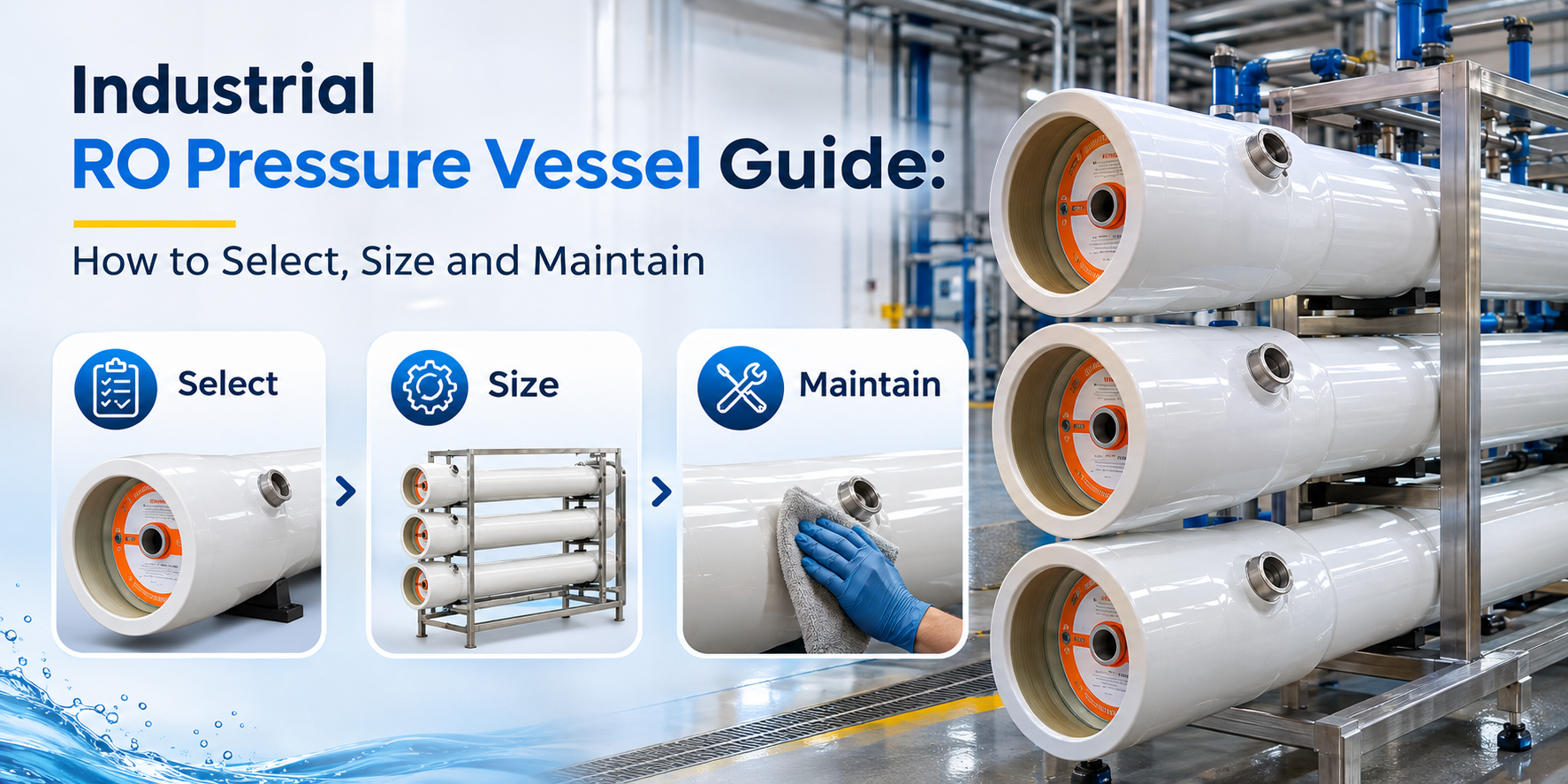
An industrial RO pressure vessel is a sealed, pressure-rated tube that holds reverse osmosis membrane elements in series and directs feed water, concentrate and permeate through them. To choose one, match five things: pressure class (above your highest operating and cleaning pressure), element size (4-inch or 8-inch), number of elements per vessel, port style (side port or end port) and shell material (usually FRP). Get these right and the vessel will protect your membranes for years. Get them wrong and the result is leaks, short membrane life or a rebuilt skid.
Key Takeaways
- The vessel is a pressure container first. Its class rating must sit above the highest pressure the system will ever see, not just the normal running pressure.
- Brackish water plants commonly use 300 to 600 psi classes. Seawater plants commonly use 1,000 or 1,200 psi classes.
- Side port vessels suit most 8-inch industrial skids. End port vessels are common on compact 4-inch systems.
- Six elements per vessel is a common design point for 8-inch industrial plants, but the right number comes from your recovery target and flow limits.
- Seals, not shells, are the usual failure point. Replace head seals and element seals at every membrane change.
What an RO Pressure Vessel Does
Reverse osmosis forces water through a semi-permeable membrane at high pressure. The membrane element cannot hold that pressure on its own, so it sits inside a vessel. The vessel has three jobs:
- Contain pressure. It carries the full feed pressure along its length with a safety margin.
- Guide the flow. Feed enters at one end, concentrate leaves at the other and permeate (the treated water) collects from the centre tubes of the elements.
- Hold the elements in place. Thrust rings, adapters and seals keep the elements aligned and stop water bypassing them.
Inside a standard vessel, elements sit end to end. Feed water flows across the first element, the concentrate from it becomes the feed to the next, and so on. The permeate tubes of all elements are joined by interconnectors and leave through the vessel’s end caps. For a refresher on the membrane itself, read What Is an RO Membrane and How Does It Work.
Anatomy of a Vessel
|
Part |
Function |
|
Shell |
Filament-wound fibreglass tube that carries the pressure |
|
Heads (end caps) |
Close both ends and hold the permeate port |
|
Retaining ring |
Locks each head in place against the pressure |
|
Head seal (O-ring) |
Seals the head to the shell |
|
Feed and concentrate ports |
Bring water in and take concentrate out (side or end) |
|
Permeate ports |
Collect treated water from the element tubes |
|
Thrust ring and shims |
Stop the element stack moving under flow |
|
Adapters and interconnectors |
Join the permeate tubes of neighbouring elements |
|
Brine seal (on each element) |
Forces feed through the element, not around it |
Pressure Class: The First Decision
Pressure class is the maximum design pressure of the vessel. It is not your operating pressure. Choose a class that clears the highest pressure the system can reach, including start-up, pump surges, chemical cleaning and any relief set point.
|
Class (psi) |
Roughly |
Typical use |
|
150 |
10 bar |
Very low pressure, ultra-low-energy brackish systems |
|
300 |
20 bar |
Low-pressure brackish water and light industrial RO |
|
450 |
31 bar |
Higher-salinity brackish water |
|
600 |
41 bar |
High-pressure brackish and second-pass concentrate stages |
|
1,000 |
69 bar |
Seawater RO |
|
1,200 |
83 bar |
Seawater RO with extra margin, warm or high-salinity feed |
For context, brackish water systems typically run at roughly 10 to 25 bar (150 to 360 psi), while seawater systems typically run at about 55 to 70 bar (800 to 1,000 psi). Arabian Gulf seawater is often saltier than the open-ocean average, which pushes the operating pressure up. If you work in the region, leave real headroom between operating pressure and the class rating.
Aqua Flair lists its 8-inch FRP vessels with a 300 to 1,200 psi range and its 4-inch vessels at 300 to 1,000 psi, depending on the model. Confirm the exact class for the model you order, and ask for the design and test pressure in writing.
Side Port vs End Port
The two designs differ in where the feed and concentrate connections sit.
|
|
Side port |
End port |
|
Feed and concentrate connection |
Ports on the shell, near each end |
Through the head, in line with the vessel |
|
Head removal |
Heads come off without disturbing the main piping |
Piping usually has to be opened first |
|
Footprint |
More compact along the length |
Longer along the length |
|
Common size |
8-inch industrial skids |
4-inch compact systems |
|
Best for |
Frequent membrane change-outs, multi-vessel racks |
Small skids and tight piping layouts |
Side port wins on serviceability, because you can pull the heads and load or unload elements without cutting any pipework. That matters when a rack holds dozens of vessels. End port is simpler to plumb on small systems and common on 4-inch designs.
How Many Elements per Vessel?
Vessels are built to hold one to eight elements in series. Aqua Flair lists 4-inch end port vessels for one and two elements and 8-inch side port vessels for one to six elements. See the full range on the RO pressure vessel category, including the 8-inch, 4-element side port vessel and the 8-inch, 6-element side port vessel.
More elements per vessel means:
- Higher recovery from each vessel, because water passes through more membrane area.
- Fewer vessels, ports and manifold connections for the same capacity.
- Higher total pressure drop along the vessel and more concentrate build-up at the last element.
Manufacturers set limits for these. As typical guidelines, an 8-inch element is usually held below about 75 gpm (17 m³/h) of feed flow and above about 12 gpm (2.7 m³/h) of concentrate flow, with a pressure drop of roughly 15 psi (1 bar) per element and 50 psi (3.5 bar) per vessel. Always check the datasheet of your membrane. Many industrial brackish systems use a two-stage array with six elements per vessel, but your projection software should set the final design.
Sizing Example
You need 10 m³/h of permeate from a brackish plant using 8-inch by 40-inch elements (about 37 m², or 400 ft², of membrane area each) at a design flux of 15 litres per square metre per hour.
- Membrane area needed = 10,000 L/h ÷ 15 = about 667 m².
- Elements needed = 667 ÷ 37 = about 18 elements.
- With six elements per vessel, that is 3 vessels.
The check: 18 elements × 37 m² = 666 m², and 10,000 ÷ 666 = 15 L/m²/h, which matches the target flux. This is an illustrative calculation. Real designs depend on feed analysis, temperature, fouling allowance and membrane model, so run a projection before you buy.
Shell Material and Construction
Most industrial RO vessels use a fibreglass-reinforced plastic (FRP) shell, made by winding glass fibre and epoxy resin around a mandrel. The fibres carry the hoop and axial load, and a resin liner protects the inside. FRP is popular because it does not corrode in saline water, it is much lighter than steel, and it is available in standard pressure classes up to 1,200 psi.
Stainless steel vessels are used in some special cases, such as high temperature or unusual chemistry, but they cost more and are less common for standard RO. If you also need non-RO filter vessels, see our FRP vessel range and the guide Why FRP Pressure Vessels Are the Future of Water Filtration.
Compliance matters on a pressure product. Many vessels are built to ASME Section X, the code for fibreglass-reinforced plastic pressure vessels, and potable applications often call for NSF/ANSI 61 materials. If your project requires either, ask the supplier for the certificate that applies to the exact model and batch, and keep it in the project file.
Installation Best Practice
- Support the shell on saddles or a frame and allow for small length changes as the vessel pressurises. Do not clamp it rigidly at both ends.
- Align the ports with the manifold before tightening. Forcing misaligned pipework into the ports puts stress on the shell.
- Load elements in the flow direction. The brine seal on each element faces the feed end of the vessel.
- Lubricate seals only with a lubricant approved by the vessel and membrane makers.
- Fit the thrust ring and shims so the stack cannot move under flow.
- Check permeate adapters and interconnectors are fully seated before closing the head.
- Fill slowly and vent air before pressurising, and ramp pressure up gradually to avoid water hammer.
- Record the clean differential pressure and permeate conductivity on day one. You will compare against them for the life of the membranes.
Good pretreatment protects the vessel and the membranes together. See high flow pleated filter cartridges and filter housings for the stage before the RO feed pump, and the cartridge filter range for the final guard filter.
Maintenance and Inspection
A vessel is mostly maintenance-free until a membrane change, but regular checks catch problems early.
|
Check |
How often |
What to look for |
|
Head and port leaks |
Daily walk-round |
Weeping at heads, ports or fittings |
|
Permeate conductivity per vessel |
Monthly, or after any rise in total permeate TDS |
One vessel with higher conductivity points to a seal or element leak |
|
Shell surface |
Quarterly |
Fibre exposure, cracks, discolouration or impact damage |
|
Retaining rings and head seals |
Every membrane change |
Wear, nicks, flattened or hardened O-rings |
|
Supports and manifold |
Every membrane change |
Loose saddles, corroded fittings, pipe strain |
Replace head seals and element brine seals every time you open the vessel. They cost little compared to the downtime a leak causes. Use water quality meters and a flow meter on the permeate and concentrate lines so you can see trends before they turn into failures. For membrane-side warning signs, read Signs Your RO Membrane Needs Replacement.
Common Problems and What Causes Them
|
Symptom |
Likely cause |
Action |
|
Leak at the head |
Damaged or dry O-ring, wrong lubricant, ring not fully seated |
Depressurise, replace the seal, re-seat the ring |
|
Higher permeate conductivity from one vessel |
Worn permeate adapter or interconnector seal, damaged element |
Probe the vessel, replace seals, check the element |
|
Element moved or telescoped |
No thrust ring or shims, pressure surge |
Reload with a thrust ring and fit a soft-start |
|
Vessel weeping or cracked port |
Piping strain, overpressure or impact |
Take the vessel out of service and inspect |
|
Pressure drop rising across a vessel |
Fouled or scaled elements, not the vessel itself |
Check feed quality and clean the membranes |
Vessel Selection Checklist
Before you request a quote, collect these details:
- Feed water type (brackish, seawater, tap, industrial) and salinity
- Maximum operating pressure, plus start-up, surge and cleaning pressure
- Required pressure class with a margin above that maximum
- Membrane element size (4040, 8040) and number of elements per vessel
- Port style and port size to match your manifold
- Number of vessels from your flow and flux calculation
- Shell material and any required certificates for the specific model
- Spare seal kits, thrust rings and adapters
- Delivery, stock position and installation drawings
Pairing Vessels with Membranes and Systems
The vessel and membrane are chosen together. Aqua Flair supplies RO membranes from FilmTec, Hydranautics and LG, as well as complete RO systems in residential, commercial and industrial sizes. For a full membrane buying guide, read The Complete Guide to RO Membranes and Wholesale RO Membranes in UAE. To see where the vessel sits in the whole plant, read How Water Treatment Systems Work. To control scaling ahead of the membranes, dosing pumps feed antiscalant at a steady rate.
If you supply projects in neighbouring markets, we also list RO pressure vessels for Saudi Arabia, Kuwait, Qatar, Oman and Bahrain.
Frequently Asked Questions
What is an RO pressure vessel?
An RO pressure vessel is a sealed, pressure-rated housing that holds reverse osmosis membrane elements in series. It carries the feed pressure and directs feed, concentrate and permeate flows through the elements.
What is the difference between a side port and an end port RO vessel?
A side port vessel has its feed and concentrate connections on the shell near each end, so you can remove the heads without disturbing the piping. An end port vessel connects through the head, which suits compact systems but needs the pipework opened to service.
What pressure rating do I need for an RO pressure vessel?
Choose a class above the highest pressure the system can reach. Brackish water plants commonly use 300 to 600 psi vessels, and seawater plants commonly use 1,000 or 1,200 psi vessels.
How many membranes fit in one RO pressure vessel?
Vessels hold one to eight elements in series. Six elements per vessel is a common design for 8-inch industrial systems, but flow limits and your recovery target decide the number.
What are RO pressure vessels made of?
Most are made of fibreglass-reinforced plastic (FRP) with an epoxy resin matrix. FRP resists corrosion in saline water, is light and is available up to 1,200 psi.
How long does an RO pressure vessel last?
A well-installed FRP vessel can serve for many years, and the shell usually outlasts several sets of membranes. Seals wear sooner, so replace them at every membrane change and inspect the shell regularly.
Can I use a vessel from one brand with membranes from another?
Standard 4040 and 8040 elements are made to common dimensions, so most fit most vessels. Always confirm the element length, adapter type and head design against the datasheets before ordering.
How do I find a leaking element inside a vessel?
Measure permeate conductivity from each vessel. A vessel with a clearly higher reading than the others is the one to probe, and a worn interconnector or adapter seal is the most common cause.
Where can I buy industrial RO pressure vessels in the UAE?
Aqua Flair Trading LLC in Dubai supplies FRP RO pressure vessels in 4-inch and 8-inch sizes, with technical help on selection. Browse the range or send your design pressure, element size and element count for a quote.
Conclusion
The pressure vessel is the part of an RO plant that nobody sees until it fails. Choose the pressure class from your real maximum pressure, pick the port style for how you will service it, size the element count from flow and flux, and treat seals as consumables. Those four habits protect your membranes and your uptime.
As a water treatment equipment supplier in the UAE, Aqua Flair Trading LLC helps you match vessels, membranes and pretreatment as one system. To specify your project, request a quote with your pressure class, element size and number of elements. Learn more about Aqua Flair.
Share this story


