


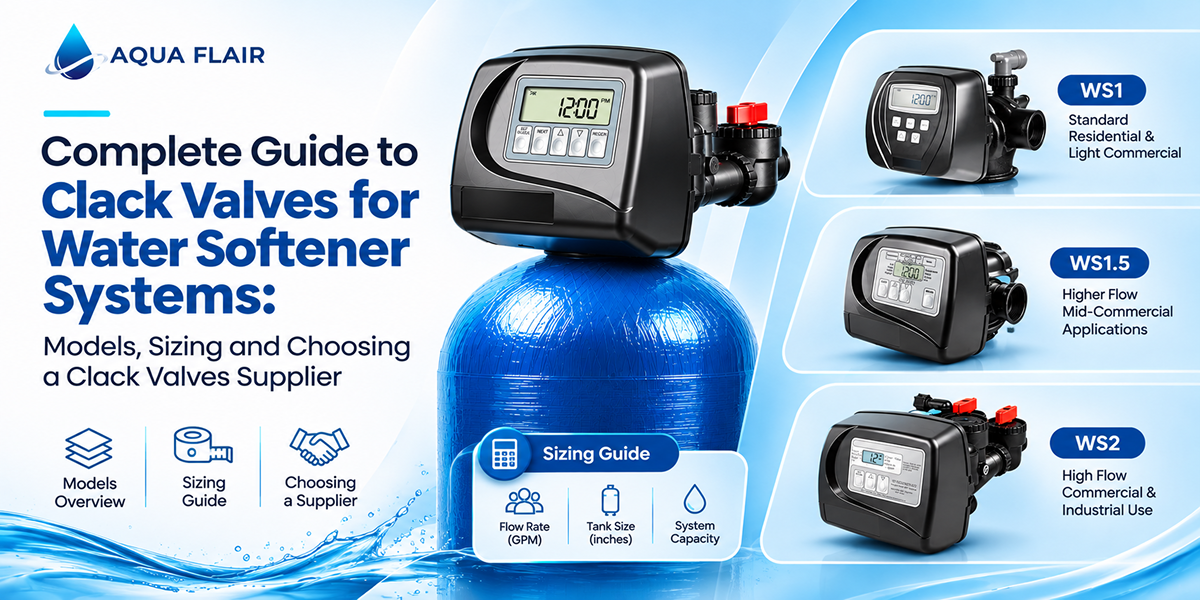
Clack valves for water softener systems are the control heads that sit on top of a softener tank (or a media filter tank) and run every cycle: service, backwash, brine draw, rinse and refill. Clack Corporation designs and tests its Water Specialist valves in Wisconsin, USA, and most projects use one of three sizes: WS1 (1 inch, about 27 gpm or 6.1 m³/h), WS1.5 (1.5 inch, about 60 gpm or 13.6 m³/h) and WS2 (2 inch, about 95 to 115 gpm or 21.6 to 26.1 m³/h). To choose one, match the valve to your peak flow and tank diameter, decide between time-clock and meter-based control, and buy from a Clack valves supplier who can provide genuine valves, the correct fittings and local support.
Key Takeaways
- A good valve with the wrong settings still wastes salt and water.
- Size the valve against two flows: the peak service flow and the backwash flow the tank needs. For media filters, backwash is often the real limit.
- TC (time clock) valves regenerate on a fixed schedule. Metered valves such as the EI regenerate on actual water use, which saves salt where demand varies.
- Twin alternating valves give soft water 24 hours a day, because one tank stays in service while the other regenerates.
- The Clack valves supplier matters as much as the model: genuine valves, correct configuration and spare parts.
What Is a Clack Valve for a Water Softener?
A water softener is a pressure tank of ion exchange resin that swaps calcium and magnesium for sodium. Once the resin is full, it must be regenerated with brine. The control valve does this automatically. It holds the programme, drives a piston to redirect the flow, draws brine through an injector, limits backwash with a drain line flow control, and refills the brine tank for the next cycle.
Clack Water Specialist valves use a piston and seal-stack design driven by a small DC motor. The same platform is configured for media filters, where it runs backwash and rinse without brine, and the controls are consistent across sizes. Many models carry NSF/ANSI 61 and 372 certification for drinking water contact.
How a Clack Softener Valve Runs a Regeneration
- Service. Hard water flows down through the resin and leaves soft.
- Backwash. Flow reverses upward, lifts and loosens the bed, and flushes trapped dirt to drain.
- Brine draw and slow rinse. The injector pulls brine from the brine tank and passes it slowly through the resin, which exchanges the hardness for sodium.
- Fast rinse. Water flushes out the remaining brine and resettles the bed.
- Refill. Fresh water returns to the brine tank to dissolve salt for the next regeneration.
On electronic models every cycle time is adjustable, and most valves in the WS1 to WS2 range can be set for downflow or upflow brining. Upflow (counter-current) brining can cut salt use on suitable systems. Clack rates these valves for 1.4 to 8.6 bar (20 to 125 psi) and water at 4 to 43 °C, which matters in the UAE, as covered below.
Clack Valve Models Explained
The table compares the three main families of Clack valves for water softener and filter duty, using Clack published ratings (service at a 15 psi drop, backwash at 25 psi). Values vary slightly by body version, so confirm the model with your supplier.
|
Valve family |
Pipe size |
Service flow |
Backwash flow |
Typical tank diameter |
Typical use |
|
WS1 |
1" |
27 gpm (6.1 m³/h) |
27 gpm |
6" to 21" |
Villas, small offices, small commercial |
|
WS1.5 |
1.5" |
60 gpm (13.6 m³/h) |
43 gpm |
12" to 24" |
Hotels, commercial buildings, light industry |
|
WS2 |
2" |
95 to 115 gpm (21.6 to 26.1 m³/h) |
80 to 85 gpm |
18" to 42" softener, 12" to 36" filter |
Industry, large hospitality, RO pretreatment |
For very large plants, Clack also builds the WS2HF (about 165 gpm) and WS3 (about 250 gpm).
Clack Control Types: TC, EI and EE
- TC (time clock). Regenerates on set days at a set time, with no flow meter. It is simple and reliable where water use is steady. Clack offers TC on the 1 inch and 1.25 inch valves.
- EI (electronic, metered). Counts the water used and starts regeneration when the resin capacity is nearly spent. It suits buildings where use changes with occupancy.
- EE (electronic). The electronic controller on the Clack WS2 valves we stock. Like the EI, it supports meter-based regeneration and programmable cycles, and its display shows flow, volume used and days to the next regeneration.
Clack WS1 TC Softener Valve
The Clack WS1 TC softener valve has 1 inch ports and a 2.5 inch top mount, and fits FRP softener tanks from 6 to 21 inches in diameter. Its time clock suits villas, small offices and cafés with predictable daily use.
Clack WS1 TC Filter Valve
The Clack WS1 TC filter valve uses the same 1 inch body, set up for backwash and rinse only. It runs sand, carbon and multimedia filters, typically on tanks of 7 to 16 inches.
Clack WS1 EI Twin Alternating Softener Valve
The Clack WS1 EI twin alternating softener controls two tanks. One stays in service while the other regenerates, so soft water never stops. Rated at 28 gpm service and 15 gpm backwash, it suits hotels, clinics, laundries and any building without a soft-water storage tank.
Clack WS1.5 EI Softener and Filter Valves
The Clack WS1.5 EI softener valve and the Clack WS1.5 EI filter valve have 1.5 inch ports on a 4 inch base. They deliver about 60 gpm service and 43 gpm backwash on tanks of 12 to 24 inches, which covers most commercial and light industrial duties.
Clack WS2 EE Softener and WS2 Filter Valves
The Clack WS2 EE softener valve and the Clack WS2 filter valve handle high flows through 2 inch ports. They work single or twin-tank on large vessels and suit hotels, hospitals, food plants and RO pretreatment. Browse the full Clack valves range to compare every model.
How to Size Clack Valves for Water Softener Systems
- Find the peak flow, not the daily average. Count fixtures or measure it with an inline flow meter.
- Test the water. Measure hardness (as mg/L CaCO₃), iron and chlorine with a lab test or hardness kit.
- Size the resin for the volume you want between regenerations.
- Choose the tank to hold the resin with room for bed expansion. See our FRP vessel range.
- Check the valve. Its service rating must exceed peak flow, and its backwash rating must cover the tank.
- Pick the control. Use TC for steady use, metered EI for variable use, and twin alternating where soft water cannot stop.
- Set the injector, drain line flow control and refill to suit the tank. Your supplier should configure these before delivery.
Worked Example: Softener for a Villa Compound Block
A villa block uses 10 m³ a day, with a peak of 3 m³/h (about 13 gpm). The feed is a tanker and well water blend at 250 mg/L hardness as CaCO₃.
- Daily hardness load: 10 m³ × 250 g/m³ = 2,500 g as CaCO₃.
- Resin capacity: at a moderate salt dose of about 96 g per litre of resin, standard cation softening resin removes roughly 45 g of hardness per litre.
- Resin volume: to regenerate every two days, 5,000 g ÷ 45 g/L ≈ 111 L, so about 110 litres of resin.
- Tank: a 16 × 65 inch FRP vessel holds about 190 litres, leaving roughly 40 percent freeboard for backwash.
- Valve check: 13 gpm peak is well inside the WS1 rating of 27 gpm, and the 16 inch bed needs only about 7 gpm of backwash.
- Control: occupancy varies, so a metered EI valve is the better choice. If the block has no soft-water storage, use the WS1 EI twin alternating with two tanks.
- Salt: about 110 L × 0.096 kg ≈ 10.5 kg per regeneration.
A time clock would regenerate every second day even with half the villas empty. A metered valve regenerates only when the capacity is used, saving salt and water.
Filter Example: Why Backwash Sets the Valve Size
Clack sizes filter tanks at about 10 gpm of backwash per square foot of bed. A 21 inch tank has about 2.4 square feet of bed and needs about 24 gpm, close to the WS1 limit of 27 gpm. A 24 inch tank needs about 31 gpm, beyond the WS1, so it moves up to a WS1.5 with 43 gpm of backwash.
Clack Valves in UAE Water Conditions
- Variable hardness. Desalinated mains water is usually low in hardness, while well and tanker water can be much harder. Test every site rather than assuming.
- Heat. Clack rates its valves for water up to 43 °C. Rooftop tanks and exposed pipes can approach that in summer, so shade the valve and feed lines.
- Dust and sand. Fine sand scores piston seals and blocks injectors. Fit a sediment stage from our cartridge filters range ahead of the softener. See our industrial filter cartridge guide.
- Chlorine and iron. Chlorine slowly damages resin, and iron fouls it. Use activated carbon media ahead of the softener where chlorine is high.
Choosing a Clack Valves Supplier in the UAE
Use this checklist when you compare suppliers:
- Genuine USA-made valves. Clack designs, assembles and tests its valves in Wisconsin. Check the labelling and packaging.
- Correct configuration. Injector size, drain line flow control, refill control, distributor tube size and bypass must all match your tank.
- A complete system. Valves, FRP vessels, ion exchange resin and prefilters from one source give you one point of responsibility.
- Spare parts. Seal and spacer kits, pistons, motors and injectors should be in stock, not weeks away.
- Technical support. Help with sizing, programming and commissioning.
Aqua Flair Trading LLC, based in Al Qusais Industrial Area, Dubai, is a Clack valves supplier stocking WS1, WS1.5 and WS2 softener and filter valves, together with the vessels, resin and pretreatment that go with them.
Installation and Programming Tips
- Fit a bypass valve so the softener can be serviced without cutting the supply.
- Size the drain line correctly, keep an air gap, and avoid long uphill runs.
- Set hardness, capacity and a night regeneration time, around 2 am.
- Keep inlet pressure within 1.4 to 8.6 bar. Add a pressure reducing valve if the supply runs higher.
- Use only silicone-based lubricant on O-rings. Clack warns that petroleum products damage the seals.
Maintenance and Troubleshooting
|
Symptom |
Likely cause |
What to check |
|
Hard water after the softener |
Empty brine tank or salt bridge, blocked injector, bypass left open |
Brine level, injector and screen, bypass position, hardness setting |
|
High salt use |
Salt dose too high, time clock regenerating too often, long refill |
Switch to metered control, review refill and capacity settings |
|
Water running to drain |
Worn seals and spacers, debris on the piston |
Replace the seal and spacer kit, clean the piston |
|
Low pressure after the softener |
Fouled resin, blocked distributor, undersized valve |
Pressure drop across the unit, valve rating against peak flow |
|
Brine tank overflowing |
Refill flow control fault, stuck brine valve |
Clean the refill control, check the brine valve |
Check salt monthly, service the injector and seals once a year, and plan resin replacement every 5 to 10 years depending on chlorine and iron in the feed.
Where Clack Softener Valves Are Used
|
Application |
Typical Clack valve |
|
WS1 TC or WS1 EI softener |
|
|
Hotels, hospitals and laundries |
WS1 EI twin alternating, WS1.5 EI or WS2 EE twin systems |
|
WS1.5 EI softener and filter valves |
|
|
WS1.5 or WS2 metered softeners and carbon filters |
|
|
RO pretreatment |
Softener and media filter valves ahead of RO systems |
|
Boiler and cooling tower feed |
WS1.5 or WS2 softeners |
Softening ahead of RO reduces scaling on the RO membranes. For a wider look at automation and pretreatment, read Clack valves for water treatment systems and how a full treatment train works.
Supplying Clack Valves Across the Region
From Dubai, Aqua Flair supplies Clack valves across the UAE and to customers in these countries:
|
Country |
Clack valves page |
|
Saudi Arabia |
|
|
Qatar |
|
|
Oman |
|
|
Kuwait |
|
|
Bahrain |
|
|
Kenya |
|
|
Angola |
|
|
Rwanda |
Delivery time outside the UAE depends on the destination and items ordered, and we confirm it in the quotation.
Conclusion
Clack valves for water softener systems give precise, automatic control, but only when the model, control type and settings match the job. Size against peak flow and backwash, choose metered control where use varies, and protect the valve from sand and chlorine.
As a Clack valves supplier in the UAE, Aqua Flair Trading LLC helps you match the valve, vessel, resin and pretreatment as one system. To specify yours, **send us your flow rate, water hardness and tank size**. Get to know the team behind Aqua Flair or browse our complete water treatment catalogue.
Frequently Asked Questions
What is a Clack valve for a water softener?
It is the automatic control head on a softener tank. It directs water through service, backwash, brine draw, rinse and refill, so the resin regenerates without manual work.
Which Clack valve size do I need?
Use a WS1 for peak flows up to about 27 gpm and tanks up to 21 inches, a WS1.5 up to about 60 gpm and 24 inch tanks, and a WS2 for larger flows and vessels. Check backwash flow as well as service flow.
What is the difference between Clack TC and EI valves?
A TC valve regenerates on a fixed time schedule. An EI valve has a flow meter and regenerates only when the set volume of water has been treated, which usually saves salt and water.
What is a Clack twin alternating valve?
It controls two softener tanks. One tank supplies soft water while the other regenerates, so the building gets soft water 24 hours a day.
Can one Clack valve run both a filter and a softener?
The valve family is the same, but filter and softener versions are configured differently, so order the version that matches your duty.
How often should a Clack softener regenerate?
It depends on resin volume, hardness and water use. Most systems are sized for every one to four days, and metered valves set the timing automatically.
Are Clack valves made in the USA?
Yes. Clack states that its control valves are designed, assembled, air tested and water tested in Wisconsin, USA.
How do I choose a reliable Clack valves supplier in the UAE?
Choose a supplier that sells genuine USA-made valves, configures injectors and drain controls for your tank, stocks spare parts and offers technical support for sizing and programming.
Share this story


